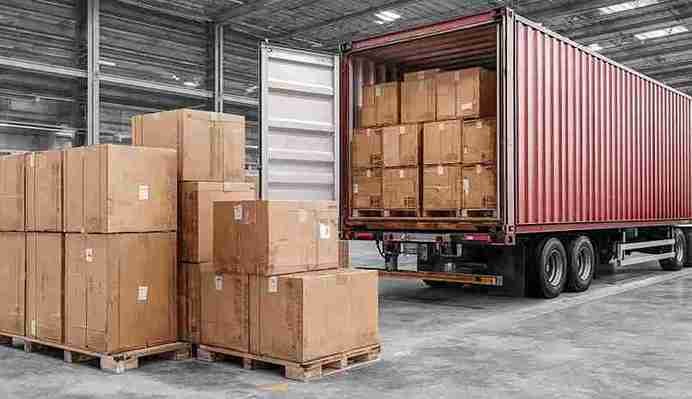
When falling, shifting, or unsecured cargo causes a truck accident in Houston, liability rests with the party that failed to load, secure, or inspect the cargo properly. That party is often the motor carrier and its driver, but it is frequently the shipper or a third-party loading company as well. Texas divides fault among every responsible party under its proportionate responsibility statute.
This article explains the legal duties that apply to cargo, the parties who carry those duties, and how liability is assigned after a cargo-related crash.
Overview of Cargo-Related Truck Accidents
A cargo-related truck accident is a collision caused in whole or in part by the load a commercial vehicle carries. These crashes take several forms:
- Falling cargo: Freight, pipe, lumber, or equipment falls from a flatbed or open trailer into traffic.
- Spilled loose material: Gravel, sand, or debris blows or spills from an uncovered load.
- Shifting cargo: An improperly braced load moves during a turn or hard stop and destabilizes the truck, causing a rollover or jackknife.
- Overloaded or unbalanced cargo: Excess or uneven weight lengthens stopping distance and impairs steering.
Houston’s freight network concentrates this risk. Container trucks leave the Barbours Cut and Bayport terminals at Port Houston, flatbeds serve the petrochemical plants along SH 225 and the Houston Ship Channel, and loaded trailers move continuously on the I-610 East Loop and I-10 East.
Legal Duties Governing Cargo Securement
Federal Cargo Securement Rules
The Federal Motor Carrier Safety Regulations set the national standard for securing cargo on commercial motor vehicles. Under 49 CFR Part 393, Subpart I, cargo must be contained, immobilized, or secured to prevent it from leaking, spilling, blowing, falling from, or shifting on the vehicle.
The rules set specific performance requirements. A securement system must withstand forces equal to 0.8 g of deceleration in the forward direction, 0.5 g in the rearward direction, and 0.5 g laterally. The regulations also set minimum numbers of tiedowns based on the length and weight of the cargo, and require that each tiedown’s working load limit be counted toward the total.
Texas adopts these federal safety regulations for commercial vehicles operating in the state.
The Driver’s Inspection Duty
Under 49 CFR 392.9, a commercial driver must inspect the cargo and its securement devices before driving, within the first 50 miles of a trip, and again at regular intervals, generally whenever the driver changes duty status or after three hours or 150 miles of driving, whichever comes first.
The rule contains an exception for sealed loads. When a driver has been ordered not to open a sealed trailer or container, or the cargo is loaded in a way that makes inspection impractical, the inspection duty does not apply to the contents the driver cannot reach.
Texas Rules for Loose Materials
Chapter 725 of the Texas Transportation Code governs trucks carrying loose materials such as sand, gravel, dirt, and aggregate. It requires those vehicles to be loaded and covered to prevent the material from blowing, spilling, or leaking onto the roadway. Violations are relevant evidence of negligence when loose material causes a crash or damages another vehicle.
Parties Who Bear Liability for Cargo Accidents
The Motor Carrier and Its Driver
The motor carrier operates the truck and employs or contracts with the driver. The carrier bears liability in two ways:
- Vicarious liability: Under the doctrine of respondeat superior, the carrier answers for the negligence of a driver acting within the course and scope of employment, including a driver who failed to inspect or re-secure a load.
- Direct negligence: The carrier is independently liable for its own failures, including inadequate securement training, defective tiedown equipment, and schedules that discourage required cargo checks.
The Shipper or Third-Party Loading Company
The shipper is the business that tenders freight for transport. In many cases, the shipper’s own employees or a hired loading company physically load, block, and brace the cargo.
Courts across the country apply a widely cited rule, often traced to United States v. Savage Truck Line (4th Cir. 1953): the carrier is primarily responsible for safe loading, but when the shipper assumes the loading and the defect is latent, meaning not discoverable through ordinary observation by the carrier, the shipper is liable for the resulting harm. A sealed container packed improperly at a warehouse is the classic example.
Identifying the Loading Party
The document that answers who loaded the truck is the cargo manifest, together with the bill of lading and any seal records. These show who tendered the freight, who loaded it, whether the trailer was sealed, and the declared weight.
A crash report usually identifies the driver and vehicle, but it does not tell the full story of who handled the cargo. The manifest and shipping records can connect the load to companies involved before the truck entered a Houston highway.
That is why Ben Dominguez Law Firm includes cargo records in its investigation of Houston truck crashes. If the evidence shows that improper loading or securement contributed to the collision, the liability analysis extends beyond the driver to the companies responsible for preparing, handling, or transporting the load.
The Freight Broker
A freight broker arranges transportation but does not haul the load. A broker is liable when it negligently selects an unsafe carrier. In Montgomery v. Caribe Transport II, LLC (2026), the U.S. Supreme Court held that state negligent-selection claims against brokers are not preempted by federal law. A broker that hired a carrier with a record of cargo securement violations faces exposure under that rule.
Equipment Manufacturers
When a strap, chain, binder, or anchor point fails under a load within its rated working load limit, the manufacturer of the defective component is liable under Texas product liability law.
Allocation of Fault Under Texas Law
Texas applies proportionate responsibility under Chapter 33 of the Civil Practice and Remedies Code. The fact finder assigns a percentage of responsibility to each party, including the claimant. The following rules govern recovery:
- A claimant more than 50% responsible recovers nothing.
- A claimant 50% or less responsible recovers damages reduced by that percentage.
- Each defendant pays its own percentage of the damages.
- A defendant found more than 50% responsible is jointly and severally liable for the entire recoverable amount.
Defendants frequently designate other parties as responsible third parties. A carrier, for example, designates the shipper that loaded a sealed container, and the shipper points to the carrier’s failure to re-inspect. The fact finder resolves that dispute through the percentages.
Evidence in Cargo Accident Claims
The evidence that establishes cargo liability includes:
- Cargo manifests, bills of lading, and seal numbers
- Loading dock records, warehouse video, and loader identity
- Photographs of the cargo, tiedowns, and anchor points after the crash
- The failed securement devices themselves
- The driver’s inspection notes and electronic logging data
- Roadside inspection history showing prior cargo violations
- Weight tickets and scale records
- Broker-carrier agreements and carrier selection records
Securement devices and loading records are lost quickly after a crash. A written preservation demand to the carrier, shipper, and broker protects them.
Damages Available
An injured person in a Texas cargo truck accident recovers economic damages, including medical expenses and lost earnings, and noneconomic damages, including physical pain, mental anguish, impairment, and disfigurement. Recovery of past medical expenses is limited to amounts actually paid or incurred under Section 41.0105 of the Civil Practice and Remedies Code. Exemplary damages require clear and convincing proof of gross negligence and are generally capped by Section 41.008.
Statute of Limitations
A personal injury claim arising from a Texas cargo truck accident must be filed within two years of the date of injury under Section 16.003 of the Civil Practice and Remedies Code. A wrongful death claim must be filed within two years of the date of death.
Summary
- Federal rules require cargo to be secured against falling, shifting, spilling, and blowing, with defined performance standards.
- Drivers must inspect cargo before and during trips, except for sealed loads they cannot access.
- The motor carrier, driver, shipper, loading company, broker, and equipment manufacturer each carry potential liability.
- The cargo manifest and bill of lading identify the loading party.
- Texas assigns each responsible party a percentage of fault, and the claim must be filed within two years.