When filing your U.S. tax return, you may have to pay both federal and state income taxes. However, these two tax systems are not the same.
The federal government has one set of tax brackets that applies across the country, while each state can create its own income tax rules. Some states use progressive tax brackets like the federal government, some charge a flat tax rate, and others don’t collect state income tax at all.
Understanding the difference between federal and state tax brackets can help you estimate your tax bill more accurately and avoid surprises during tax season.
In this guide, you’ll learn:
- What federal tax brackets are
- What state tax brackets are
- The biggest differences between them
- Which states have no income tax
- How federal and state taxes work together
- Common questions taxpayers ask
Federal vs. State Tax Brackets: Quick Comparison
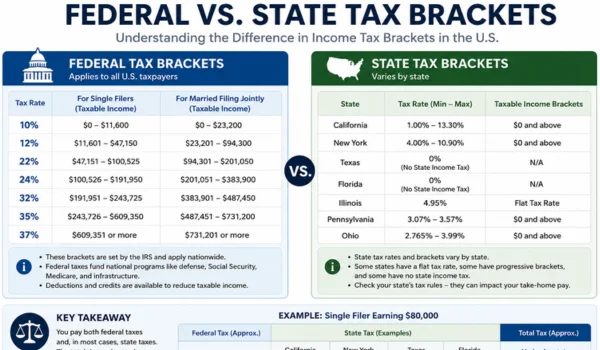
| Feature | Federal Tax Brackets | State Tax Brackets |
| Who sets them? | IRS (Federal Government) | Individual State Governments |
| Apply nationwide? | Yes | No |
| Same in every state? | Yes | No |
| Updated annually? | Usually Yes | Depends on the state |
| Progressive system? | Yes | Depends on the state |
| Filing required? | Usually Yes | Depends on state law |
What Are Federal Tax Brackets?
Federal tax brackets are income ranges established by the Internal Revenue Service (IRS) to calculate federal income tax.
The United States uses a progressive tax system, meaning different portions of your taxable income are taxed at different rates.
Federal tax brackets:
- Apply to taxpayers in every state
- Are updated annually for inflation
- Depend on your filing status
- Apply only to taxable income
Whether you live in California, Texas, Florida, or New York, the federal tax brackets are the same nationwide.
What Are State Tax Brackets?
State tax brackets are income tax rates created by individual state governments.
Unlike federal taxes, every state decides whether to:
- Have progressive tax brackets
- Charge one flat income tax rate
- Not charge state income tax at all
Because of this, your state income tax can vary significantly depending on where you live.
How Federal and State Income Taxes Work Together
Most taxpayers file:
- A federal income tax return.
- A state income tax return (if required).
These are separate tax systems.
For example:
If you earn $80,000 in a state with income tax:
- You may owe federal income tax to the IRS.
- You may also owe state income tax to your state.
The two taxes are calculated separately.
Are Federal and State Tax Brackets the Same?
No.
Although some states also use progressive tax brackets, their:
- Tax rates
- Income thresholds
- Standard deductions
- Tax credits
- Filing rules
can all differ from federal tax rules.
For example, someone living in New York and someone living in Texas may owe the same amount of federal income tax but very different amounts of state income tax.
Types of State Income Tax Systems
States generally use one of three systems.
- Progressive Tax System
Like the federal government, many states tax higher levels of income at higher rates.
As your taxable income increases, only the income within each bracket is taxed at the higher rate.
Examples include several states that have multiple tax brackets.
- Flat Income Tax
Some states charge one tax rate regardless of income.
Whether you earn $40,000 or $200,000, the same percentage applies to taxable income under state law.
- No State Income Tax
Several states do not impose a personal state income tax.
Residents in these states generally pay only federal income tax on their earnings, although they may still owe other taxes such as sales or property taxes.
States With No State Income Tax
As of 2026, these states generally do not impose a personal state income tax:
- Alaska
- Florida
- Nevada
- New Hampshire*
- South Dakota
- Tennessee
- Texas
- Washington
- Wyoming
Note: New Hampshire no longer taxes wage income but may have different rules for certain types of income in previous years. Always review current state tax guidance before filing.
Which Tax Do You Pay First?
Federal and state taxes are calculated separately.
When you receive your paycheck:
- Federal income tax may be withheld.
- State income tax may also be withheld if your state has an income tax.
At tax filing time, you’ll reconcile both amounts separately.
Example of Federal vs. State Taxes
Suppose Emma lives in California and has:
- Taxable Income: $75,000
She may owe:
- Federal income tax based on IRS tax brackets.
- California state income tax based on California’s tax rules.
Now imagine Jake earns the same amount but lives in Texas.
Jake still pays federal income tax, but Texas does not levy a personal state income tax. As a result, he generally owes no state income tax on his wages.
This example shows why location can affect your total tax bill even when incomes are identical.
Which Is Usually Higher?
It depends.
Federal income tax is generally the larger portion of a taxpayer’s income tax liability.
However, some states have relatively high income tax rates, while others have none.
Your overall tax burden depends on factors such as:
- Income
- Filing status
- State of residence
- Available deductions
- Tax credits
Do All States Have Tax Brackets?
No.
Some states:
- Have multiple tax brackets.
- Use one flat tax rate.
- Do not collect personal income tax.
This is one reason why moving to another state may affect your overall tax liability.
Can You Move to Save on Taxes?
Some people relocate to states with lower or no income tax.
However, state income tax is only one part of the picture.
You should also consider:
- Cost of living
- Property taxes
- Sales taxes
- Housing costs
- Employment opportunities
- Healthcare and insurance costs
A state with no income tax may have higher taxes in other areas.
Common Misconceptions
Myth 1: Federal and State Tax Brackets Are Identical
False.
Federal tax brackets are nationwide, while state tax systems vary.
Myth 2: Every State Charges Income Tax
False.
Several states do not impose a personal state income tax.
Myth 3: Moving to Another State Eliminates All Taxes
False.
Even if your state has no income tax, you’ll generally still pay federal income tax and may owe sales, property, or other state and local taxes.
Tips for Managing Federal and State Taxes
- Review your paycheck withholding each year.
- Understand your state’s filing requirements.
- Keep records of deductions and credits.
- File both federal and state returns on time, if required.
- Use official IRS and state tax resources to stay updated on annual changes.
Frequently Asked Questions (FAQs)
What is the biggest difference between federal and state tax brackets?
Federal tax brackets are set by the IRS and apply nationwide, while state tax brackets are determined by each state and vary across the country.
Do all states have income tax?
No. Several states do not impose a personal state income tax.
Can I owe federal tax but not state tax?
Yes. If you live in a state with no personal income tax, you may owe only federal income tax on your earnings.
Which is more important: federal or state tax?
Both are important. Federal taxes fund national government programs, while state taxes support services such as education, transportation, and public safety within the state.
Can federal and state tax brackets change?
Yes. Federal tax brackets are generally adjusted each year for inflation, and states may also update their tax laws, rates, or income thresholds.
Final Thoughts
Federal and state tax brackets work together to determine how much income tax you owe, but they operate under different rules. Federal tax brackets are the same across the United States and use a progressive tax system. State tax brackets, on the other hand, depend on where you live and may be progressive, flat, or nonexistent.
Understanding these differences can help you estimate your tax liability more accurately, plan your finances, and make informed decisions if you’re considering relocating to another state.