Texas Voters Set First-Day Early Voting Records: What the Historic Turnout Means for the 2026 Midterm Elections

Texas voters have sent a strong signal ahead of the November 2026 midterm elections, with several major counties recording exceptionally high turnout on the first day of early voting. Dallas County reported more than 76,000 early voters, while Harris County in the Houston area recorded more than 104,000 ballots on October 19, 2026. The figures have drawn attention because they exceed previous first-day turnout benchmarks for midterm elections in these counties.
The development is significant for Texas politics, where statewide elections have often been competitive in fundraising and campaign intensity, even as Republicans have maintained a strong position in statewide offices for many years. However, record turnout does not automatically mean that one political party is winning. To understand what the numbers could mean, it is important to examine the latest figures, the history of Texas voting patterns, and the political contests shaping this election.
What Happened on the First Day of Early Voting?
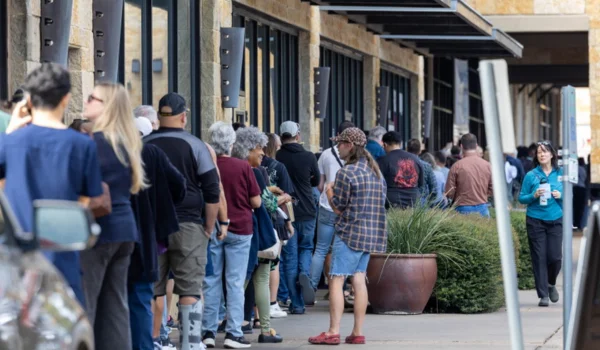
Early voting for the November 3, 2026, general election began on Monday, October 19. The first-day figures showed unusually strong participation across several major Texas counties, including Democratic-leaning urban areas and traditionally Republican regions.
The reported figures highlight the scale of participation:
| Texas county | First-day early votes in 2026 | Historical comparison |
| Harris County | Nearly 105,000 | About 63,000 in 2018 |
| Dallas County | 76,079 | 59,389 in 2018 |
| Tarrant County | 50,409 | 29,197 in 2022 |
| Denton County | 34,739 | About 17,000 more than in 2022 |
| Collin County | 34,522 | About 15,000 more than in 2022 |
Sources: Houston Chronicle and NBC 5 Dallas-Fort Worth. Figures are reported opening-day totals; comparisons use the specific election years shown, not necessarily the same type of election in every case.
Dallas County’s opening-day figure was particularly notable because it exceeded the 56,431 ballots reported on the first day of early voting in the 2024 presidential election. Harris County also substantially surpassed its 2018 midterm opening-day benchmark.
These figures demonstrate that voter engagement has started strongly. However, they represent only the beginning of the early-voting period, and they do not establish how many people will vote by Election Day.
Why Is This Election Important for Texas Politics?
The 2026 midterm election is attracting particular attention because of the closely watched U.S. Senate contest between Republican Ken Paxton and Democrat James Talarico. The race has become a central focus of both parties as Democrats seek a statewide victory in a state where Republicans have dominated major statewide offices for many years.
Harris and Dallas counties are especially important to Democratic electoral strategy because of their large populations and Democratic-leaning voting patterns. High turnout in these areas can increase the number of votes available to Democratic candidates, although the final impact depends on turnout and vote preferences elsewhere in Texas.
Republicans, meanwhile, are relying on strong participation in conservative counties to maintain their statewide advantage. Montgomery County and parts of the Texas Panhandle are among the areas being watched by political strategists.
The election therefore presents a broader question: can Democrats translate strong urban participation into enough statewide support to overcome Republican strength in other parts of Texas?
The first-day numbers are relevant to that question, but they cannot answer it on their own.
The History Behind Texas’s Early-Voting Records
To understand why the latest figures matter, it helps to look at the recent history of Texas elections.
The 2018 midterm election
The 2018 midterms demonstrated that Texas could experience significant political mobilization outside presidential election years. Harris County recorded approximately 63,000 votes on the first day of early voting, while Dallas County recorded 59,389. Those figures provide an important benchmark for comparing the 2026 turnout.
The 2020 presidential election
The 2020 election brought intense national attention to Texas, as it did to the rest of the country. Presidential elections generally attract a different level of attention and participation than midterms, so comparing turnout between these election cycles requires caution.
The broader historical lesson is that turnout can change substantially depending on the candidates, political issues, campaign activity and voters’ perceptions of what is at stake.
The 2022 midterm election
In 2022, Dallas County recorded 32,605 votes on the first day of early voting, according to figures cited by NBC 5. The 2026 opening-day total of 76,079 was more than twice that amount. Tarrant, Denton and Collin counties also recorded more first-day votes in 2026 than in 2022.
This comparison is particularly useful because both elections were midterms. It suggests a substantial increase in early participation, though it does not establish whether the same increase will persist throughout the entire voting period.
The 2024 presidential election
The 2024 election provides another useful comparison. Dallas County’s first-day total in 2026 exceeded its opening-day turnout in 2024, even though presidential elections typically receive considerable attention. Denton and Collin counties, by contrast, recorded fewer first-day voters in 2026 than in 2024.
This variation matters: the turnout pattern is not uniform across Texas. Each county has its own population, political composition, election calendar and mobilization efforts.
Does Record Turnout Mean Democrats Are Winning?
Not necessarily. This is one of the most important points in understanding the news.
Democratic leaders have welcomed the strong opening-day numbers in Harris and Dallas counties, arguing that increased participation in these population centers could help their candidates. Republican leaders, however, are emphasizing the need to mobilize their own supporters in conservative areas.
There are three major reasons why early-voting numbers cannot predict the final winner by themselves.
First, turnout figures do not reveal how people voted. Election officials can count ballots, but the raw totals do not show the choices made by individual voters.
Second, both parties can benefit from increased participation. High turnout in Democratic-leaning counties may help Democrats, while increased participation in Republican strongholds can strengthen Republican candidates.
Third, the first day may not represent the entire electorate. People who vote early may differ from those who wait until later in the voting period or Election Day. Campaigns also continue mobilizing supporters as the election approaches.
The Texas Tribune’s October 20 analysis highlighted these limitations, cautioning that analysts should wait for more data rather than draw firm conclusions from a single day.
The more useful indicators will be cumulative turnout, participation across different regions, the number of new or infrequent voters, and the final results.
Why Harris and Dallas Counties Matter So Much
Harris County, home to Houston, is Texas’s most populous county. Dallas County is another major population center with substantial electoral importance.
Because statewide elections are decided by votes across the entire state, large counties can have a considerable influence on the final result. A relatively small change in participation across a large electorate can translate into tens of thousands of additional ballots.
The Democratic Party’s challenge is to convert strong participation in urban counties into enough statewide votes to compete effectively. Republicans must maintain their support in rural and suburban areas while preventing Democratic gains in major metropolitan regions from becoming decisive.
The latest turnout figures are significant because they show that mobilization is not confined to one locality. Montgomery County, a Republican stronghold, also reported record midterm opening-day turnout, while Ellis, Bell and McLennan counties recorded strong participation.
That broader pattern makes it premature to describe the election as a guaranteed victory for either party.
What Are the Main Issues Facing Texas Voters?
The 2026 election includes federal, state and local contests. Voters will choose candidates for the U.S. Senate and House of Representatives, statewide offices, the Texas Legislature, judicial positions and various local races and ballot measures.
The high turnout may reflect several overlapping factors:
- National political divisions: Federal policy and the direction of the country can motivate voters to participate in midterm elections.
- Competitive statewide races: The Senate contest between Paxton and Talarico has given voters a prominent race to follow.
- Campaign mobilization: Political parties and advocacy groups are encouraging supporters to vote before Election Day.
- Local concerns: State and county races allow voters to influence decisions involving public services, schools, infrastructure and other local matters.
These are plausible contributing factors, not proven explanations for every ballot cast. The available turnout figures alone cannot establish why individual voters decided to participate.
Early-Voting Dates and What Voters Need to Know
According to the Texas Secretary of State, the early-voting period for the November 2026 general election runs from October 19 through October 30, with Election Day scheduled for November 3. The state also announced a record 19,041,684 registered voters ahead of the election.
The registration figure is important context: Texas has a large electorate, and the number of registered voters has increased by 2.2% compared with the November 2024 general election. However, registration is not the same as actual turnout. Only ballots cast will determine the election outcome.
Eligible voters should check their registration, confirm their county’s voting locations and hours, and review the identification requirements before heading to the polls. Official information is available through VoteTexas.gov.
What Happens Next?
The next stage will be to see whether the strong first-day participation continues through October 30.
Political observers will be watching several developments:
- Whether Harris and Dallas counties maintain their high participation levels.
- Whether Republican-leaning counties increase their turnout enough to narrow the gap in participation.
- Whether young, first-time and infrequent voters contribute significantly to the totals.
- Whether the final statewide turnout supports the early indications of unusually high engagement.
Campaigns will also continue their efforts to persuade undecided voters and encourage supporters who have not yet voted to participate.
The ultimate test will be the November 3 results. Until then, early-voting statistics should be treated as indicators of participation rather than predictions of victory.
Conclusion
The record-breaking first day of early voting in Texas is an important development in the 2026 midterm election. Harris County recorded nearly 105,000 first-day voters, while Dallas County reported 76,079. Several other counties also exceeded their first-day turnout in the 2022 midterms, demonstrating a substantial increase in early participation.
The numbers are particularly significant because Texas is facing an intensely watched U.S. Senate contest and a broad range of federal, state and local races. Democrats may benefit from stronger turnout in major urban counties, but Republican areas are also seeing considerable participation.
The central takeaway is that Texas voters are turning out in unusually large numbers, but turnout alone does not determine which party will win. The remainder of the early-voting period and the final Election Day results will provide a much clearer picture of the state’s political direction.